
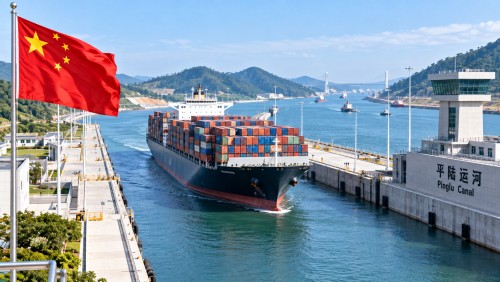
China has inaugurated the Pinglu Canal in the Guangxi Zhuang Autonomous Region, establishing a more efficient waterway connecting southwest China to the sea. This strategic infrastructure project is expected to bolster trade links with Southeast Asia by providing a faster and more cost-effective route for transporting goods.
The Pinglu Canal, stretching 134.2 kilometers and constructed at a cost of approximately 72.7 billion yuan ($10.75 billion), links Hengzhou to the Beibu Gulf. It is an integral part of the New International Land-Sea Trade Corridor, which aims to connect China’s inland areas with ASEAN markets and other international destinations. Capable of accommodating vessels up to 5,000 tonnes, the canal significantly reduces the traditional inland waterway route to the sea by over 560 kilometers, promising to reduce logistics costs by 18% to 30% and potentially saving more than 5 billion yuan in transportation expenses each year.
The canal’s strategic significance is particularly notable for southwest China. Businesses in this region have historically faced higher costs when exporting goods to coastal ports. The new route will facilitate the export of coal, grain, minerals, new-energy materials, and automobile parts, offering a more direct path to overseas markets.
Equipped with three navigation hubs featuring twin-line ship locks, the Pinglu Canal manages a 65-meter difference in water levels. Environmental sustainability has been a key consideration in the project’s development, with over 98% of the excavated materials being reused. Additionally, the canal incorporates water-recycling systems to conserve more than 1 billion cubic meters of water annually and includes features like a fish passage and wildlife crossing.
As China deepens its economic ties with ASEAN, its largest trading partner, the new canal is poised to enhance economic integration and investment opportunities along its route. China-ASEAN trade surpassed $1 trillion in 2025, with trade between the two reaching $744.41 billion in the first seven months of 2026, underscoring the canal’s role in facilitating robust economic exchanges.